Monday, March 18, 2013

Got Grace?


Lent 3-C & St. David’s Day
March 3, 2013 
Exodus 3:1-15
Ps. 63-1-8
1 Thessalonians 2:2b-12
Luke 13:1-9

“Almighty God, you know that we have no power in ourselves to help ourselves …”

In the first few hundred years of Christianity, those would have been fighting words. That phrase sums up one of the major theological controversies of the church, a battle which raged over what it meant to say that humans had “free will” – over what the grace of God meant in our lives. Were human beings born into “original sin” and so helpless – “we have no power in ourselves to help ourselves” – or were we born innocent of wrong-doing, and so able to reject sin and choose goodness on our own? Were we utterly dependent on the grace of God, or could we go it on our own? David, the patron saint of Wales, our own parish namesake, a kindly and good bishop, a scholarly and eloquent preacher, a man who just wanted to stay home in his own monastery and cell, to pray, to study, to receive the sacrament and dwell in peace, was drawn into two major councils, synods, conferences, where his eloquent denunciation won the day, and the heresy of Pelagianism was defeated.

Pelagius was an English theologian, from the 4th century – 200 years before David – and that phrase “we have no power in ourselves to help ourselves” seemed to him the ultimate cop-out. Pelagius was a reformer: clergy and laity alike, he believed, needed to improve their moral behavior, and that improvement would be impossible with all this talk about dependence on the grace of God. For Pelagius, the line, “we are all sinners from before our birth” meant that no matter how badly anyone behaved, they could claim the depravity of original sin; why be good, if the grace of God would always save you? Human beings should choose to follow the example of goodness in Christ; human beings could progress from sinfulness to holiness.

I don’t know if any of you have ever been around any church meetings where controversial topics are discussed, but the phrase, “How many angels can dance on the head of a pin?” about sums up how arcane and complicated the arguments on both sides can become. But in this fight, what Augustine, and his followers like our very own David, cared about was grace: the grace of God, God’s free gift that we cannot possibly ever earn or deserve or work hard enough to attain. God’s grace, theologians like David believed, was so expansive and so good, that we could not possibly work out a plan to get there on our own. All God wanted was for us to bask in that grace – “to love God and do what we will,” in Augustine’s words.

So if you think about grace as something we humans could never possibly earn or deserve, this peculiar story from today’s Gospel begins to make sense. Jesus uses these strange parables – about the tower that fell and killed 18 people, and about the fig tree that might need a little more manure to flourish – to shake up his hearers and to get them thinking about the power of God.

Let’s take these two parables one at a time: the suffering and death Jesus talks about comes to everyone, the sinners and the repentant, the just and the unjust. So from what is he saying we are supposed to repent? How sinless can one be to prevent one’s death? And how foolish does that sound for us humans to say such a thing – that if those 18 killed when the tower of Siloam fell on them had just been a little better they would not have died? How foolish does that sound when the only truly sinless one – Jesus, the God in human flesh – is marching toward a horrible and undeserved death on a cross?

And then the fig tree: do we really think that if we do a little bit here, a little bit there, it will all work out? The figs will grow and we will all live happily ever after?

That is what grace is about: we can never possibly do enough. But at the same time, we are free: if we acknowledge there is nothing worse that can happen to us than death, then we have nothing to fear. We are let off Scot-free, just as Pelagius feared. The grace of God frees us from being trapped by our own bad behavior, frees us to love God and to love our neighbors and all the rest of creation, just as God would have us do. No work, no worry; just let go.

David of Wales came into this world in difficult circumstances. His mother was “seduced” by the son of the local strongman, and she went off to live in a remote place to bear the child. Legend has it David was born during a great thunderstorm. All the accounts of David’s life agree that his mother was “outraged by violence,” and retired to a chaste and holy life. As a bishop, David cared for widows and orphans, protecting these vulnerable victims of the violence of their time. He lived a rigorously abstemious life, drinking only water and eating no meat, and, as is common to the accounts of lives of Celtic saints, the natural world always rose up to bless and nurture David.

At the church council where David was pressed to make his case against the Pelagian heresy, the synod where he was made the bishop of all Wales, the accounts tell us,

While S. David’s speech continued, a snow white dove descending from heaven sat upon his shoulders; and moreover the earth on which he stood raised itself under him till it became a hill, from whence his voice was heard like a trumpet, and was understood by all, both near and far off: on the top of which hill a church was afterwards built, and remains to this day.[i]

“Almighty God, you know that we have no power in ourselves to help ourselves …”

Why should we want such power to help ourselves, when the grace of God sends snow white doves to sit on our shoulders, and raises the very earth under our feet?


[i] Sabine Baring-Gould, The Lives of the Saints, Vol. III, p. 12 (Edinburgh: John Grant, 1914)

The saving embrace of the cross


Last Epiphany C; Feb. 10, 2013
Exodus 34:29-35
Psalm 99
2 Corinthians 3:12-4:2
Luke 9:28-43

“This is my son, my chosen. Listen to him!”

Where have we heard that before? Well, not exactly that but something very similar:

”You are my son, my beloved. With you I am well pleased.”


Today we are reading form the 9th chapter of the Gospel of Luke, but way back there on the first Sunday of Epiphany, the first Sunday in January, on the day of Ava’s baptism and the first communion, we read from the 3rd chapter: the story of Jesus baptism. In that story, as in today’s, the voice of God thundered from the heavens. God talked about – or to – Jesus, God’s beloved Son, the one God chose to do God’s work here on earth. When he was baptized, God said, “With you I am well pleased.” Today, however, on the mountain of the Transfiguration, with only three disciples to witness it, with Moses and Elijah at Jesus’ side, God thunders, “Listen to him!”

Listen to Jesus. If we were there, on that mountain with Peter, James and John, listening to Jesus, what would Jesus be saying?

These two stories bookend our season of Epiphany, the time when we have been reading about how the light of Christ shines in the world. Way back there at the baptism, God’s pronouncement heralded the beginning of Jesus’ work of announcing the Kingdom of heaven – the rule of God – life lived in the here and now the way God intended us to live. This Kingdom of heaven, as Luke depicts it, is a kingdom of reversals, an upside down kingdom. 
  • Remember Mary’s song when she learns that she is carrying Jesus: the mighty are cast down from their thrones, and the humble and meek are exalted. 
  • Remember what John the Baptist said to the people anxious about what this new rule of God might mean: share your coats, don’t steal, don’t cheat. 
  • Remember what happened at the wedding party at that out-of-the-way place of Cana, when scarcity and deprivation was turned into abundance and joy.
  • Remember what made the people of Nazareth so mad at the hometown boy; Jesus told them that God’s blessings came to outsiders, not only the traditional chosen ones. 
When Jesus healed the sick, he healed their social status as well. Women, lepers, paralytics, beggars, the outcast of society: Jesus restored them to health, and restored them to the community as well. The first thing Jesus did when he came down from the Mount of Transfiguration was to heal the boy possessed by the demon. He restored that boy to his family: “He gave him back to his father.” When Jesus healed, he reversed the social order that expected the privileged to be at the center and the poor and sick on the outs. Jesus proclaimed a holy community, a whole community, with a radical equality. That is the light that has been shining on us all through this season of Epiphany.

“This is my Son, my Chosen. Listen to him!”

What is it that Peter, James and John are supposed to hear, up there, on that mountain? This is not the first time we encounter these three: remember them fishing on the Sea of Galilee, remember when Jesus said, “Do not be afraid; from now on you will be catching people.” And “they left everything and followed him.” When Jesus talks to the disciples, to those who are following him, or who say they want to follow him, Jesus talks about what it costs to follow him. There’s a cost to discipleship, a cost to this upside-down kingdom where the privileged are brought low and the desperate raised up, where the playing field is leveled and there is always enough to go around. There’s a cost. It makes people mad to challenge that much power.

Just before the trip up the mountain, Jesus had said this to the disciples: “If any want to become my followers, let them deny themselves and take up their cross daily – daily – and follow me. For those who want to save their life with lose it, and those who lose their life for my sake will save it.” That is the cost of discipleship, Jesus tells his disciples. Of course, that is not what they want to hear, up on this lovely, shining mountain top. They don’t want to hear the possibility of betrayal and death, and yet that is just what God means when he says, Listen to him.

Wednesday is Ash Wednesday, the time when we remember our mortality, confess our sins and strip down our spiritual selves in preparation for the Easter Feast. But we also mark ourselves with the sign of our discipleship. We have ashes put on our foreheads in the shape of a cross. We wear, at least for a short time, anyway, an outward and visible sign of how much the world disapproved of Jesus, a sign of betrayal, a sign of violence and power, a sign of death.

Yet even as following Jesus meant bearing that cross daily, the cross also means, in the words of writer Toni Morrison, “the human figure poised to embrace.” It is a sign, then, of the love of God, in human form – a light that not even the darkness of those ashes can quench.

Be an EPIPHANY of God


Epiphany 4-C Feb. 3, 2013
Jeremiah 1:4-10
Psalm 71
1 Corinthians 13:1-13
Luke 4:21-32

Scene 1. Jesus, the hometown boy, preaches the good news to his home congregation. The poor folks of Nazareth like this Good News, because it blesses their understanding of themselves: God WILL vindicate US. God is on OUR side. They applaud when Jesus says, “Today this scripture has come true in your hearing.” They love Jesus.

That was last week’s Gospel. Today picks up right after that.

Scene 2. Jesus, the hometown boy, throws it all back in their faces. “You want me to do the things I did in Capernaum? Hah! You won’t accept me, really. You think it’s all about YOU. What do you suppose God was up to here?” He tells them one story, and then another, of biting incidents of God gracing outsiders, aliens, troublemakers, instead of the chosen people. He makes them so mad they try to throw him off a cliff. They hate Jesus.

One modern criticism leveled against religion is that all we are doing is creating a God in our own image, a God who fits our world view. Prayer to this God is to meet our needs, and we can be utterly dependent on this God, in a mindless way, because we are assured that this God, our creation, will do and say just what we need God to do and say.

That’s not such a modern criticism. You could say that that’s what Jesus is doing in this story. You might like that Good News I just quoted from Isaiah, he says, the release for the captives, the light for the blind, the acceptable year of the Lord’s favor, and yes, it’s true. But it applies not only to you. It applies to outsiders, to heathen, to the unclean, to anyone whose attitudes make you cringe and whose lifestyle makes you throw up. It’s the challenge that any serious spiritual tradition makes to the believer, or community of believers, that want to keep things cozy and their God domesticated. It’s what Jesus said all along: don’t stop with me; look through me to the one who sent me, listen to the one who sent me. Don’t let your God be too small.

The first lesson also tells of a prophet who had a hard time getting people to listen to God. This is the story of the call of Jeremiah, God as a discernment committee of ONE saying to Jeremiah, Don’t worry about your insecurities; you shall speak what I command you. You shall have my authority, “to pluck up and to pull down, to destroy and to overthrow, to build and to plant.” God didn’t say to Jeremiah, you have to be nice, you have to follow the community norms, you have to be patient, work with the people, bring them along, get a process consultant. No. You, Jeremiah. You speak for me. Tear down. Build. Plant. Be an Epiphany of God.

Predestination. Jesus and Jeremiah were predestined to be prophets. God knew when they were in the womb what they would do and what they would say. Now you recall the dark side of predestination from the heyday of the Protestant Reformation: the elect (us good guys) would be saved; the rest (you know who – whoever) would be damned. But if we listen carefully to what God says to Jeremiah, and what Jesus says, predestination is not about salvation, but about service. God is calling you forth; whom do you serve? To whom are you to speak, and from whom do you hear God speaking? The people of Nazareth did not like Jesus implying that God was speaking through widows in Sidon and not in Israel, or Syrian lepers instead of Jewish ones. Their God wouldn’t do such things. In response, they tried to throw Jesus off the hill, but he just walked through them and went on his way.

So here is our challenge: we read the call of Jeremiah, and realize, too, that we are called to be epiphanies of God, to let God’s light, God’s good news shine forth in the world. And we are reminded by Jesus that that world is wider than we first thought it would be. We are given a choice:
  • to let God slip away, because the idea of Good News for the whole world is too upsetting to our world view;
  • or to enter into God’s imagination where barriers are torn down, injustices overthrown, scarcity destroyed, and mercy and abundance planted in their place.

Saturday, February 2, 2013

God’s promises will be true tomorrow, even if we do not know what the community of the people of God will look like


Epiphany 3-C
Annual Meeting 
January 27, 2013
Nehemiah 8:1-3, 5-6, 8-10
Ps. 19
1 Corinthians 12:12-31a
Luke 4:14-21

The passage we read from Nehemiah this morning tells a remarkable story. The people of Israel have come back home: they have been released from their captivity in Babylon -- to rebuild their city and their Temple, which is the center of their religious and social life. The first thing they do when they get there is to read the law: to remember the relationship God established with them. The law is more than a set of rules: it is the bonds and the boundaries of this relationship. They are going to be able to restore things to the way they used to be, and they are profoundly grateful. Their feasting – eating fat and drinking sweet wine and making sure that everyone has enough to eat – this is a sign that their grief is over, that their joy has returned.

It would be one thing, of course, if we could tell this story as one of a blameless people, carried off into exile by a conquering enemy. The enemy conquered them, but the prophets who spoke for God told the story this way: Israel had been disobedient. They had not followed the law. The people were selfish, corrupt, thought of themselves and not of others. The prophets condemned Israel for following gods of greed and self-centeredness, gods which turned them away from the communal responsibilities to the poor, the widowed, the downtrodden. According to the prophets, God sent those conquering enemies into Israel for a reason: the people of Israel had disobeyed God. The people would protest: Hey! This is the way we have always done things! But, no, the prophets would say, that “old way” got twisted, distorted. That “old way” strayed from the way God would have them live. When God let them go back, they needed to promise once again to God that they would be people of the law, of justice, of mercy, of compassion -- that they would worship only God and live rightly.

The Gospel of Luke sees John the Baptist – and probably Jesus, in this story of his speaking in his hometown synagogue – as prophets in the line of those who chastised Israel from straying from the covenant. Prophets don’t condemn for all time: they shout out to give you a chance to turn around. It’s not too late – yet! – prophets say. You have still got time to get it right, to live right with God, you still can love God and love your neighbor. Prophets grab people by the collar and yank them around to face the future. That future is where you are going to live the rest of your life: now is your chance to change your life, to live it the way God would have you live it. There is always time to claim a future of abundance, love and mercy. There is always a way to plan the future so that there is enough for everybody, a future not constricted by the way things used to be, by that old-time “business as usual.”

Jesus, like the other prophets, reminded the people of God of this. In this his first sermon he reads a piece of scripture they knew well, a piece from that time when they came back to a shattered home. Jesus reminds them of God’s promise to rebuild, to restore. But Jesus does not let them stay in that comfortable, if glorious, past. TODAY, Jesus says, the scripture has been fulfilled in your hearing. TODAY: not in the past, no matter how good or bad it was. God’s promises are true TODAY, and they have a certain shape. But God’s promises will also be true when TOMORROW is TODAY – God’s promises will be true tomorrow, even if we do not know what the community of the people of God will look like. God’s promises – the good news of abundance will come to the poor, even if today we cannot possibly imagine what it would be like to redistribute wealth and privilege. Captives will be set free, even if now we have no idea what it would take to rehabilitate people who have done terrible things and return them to productive life in our society. Blind people – physically blind – will be able to see, even if today any surgeon would tell you it’s not possible. Blind people – spiritually blind – will see and understand what God is doing for justice and righteousness, even if now their hearts are hardened against all change. People who are oppressed by all sorts of burdens – people like you and me – will be freed from what ails us. We will live the lives that bring us God’s peace and prosperity, God’s serenity and simplicity, even if right now we cannot possibly imagine a way out of our rut of struggle and debt and discontent.

Those people listening to Nehemiah might have wanted Jerusalem to be the same when they got back, but it was changed, for ever and ever. Some things were GONE and could not be resurrected. But what all the prophets told them – and what Jesus was telling the people in Nazareth – was that they could take the most precious thing they had -- the love of God -- and carry it with them into the future. The love of God was the foundation upon which they would build the new Jerusalem, not some old stones that conquering armies have shattered. What was really important they had with them TODAY and they would take it with them into the future.

TODAY, Jesus says, you can believe that God’s promises are TRUE, even if you cannot imagine what that will look like. Your future, Jesus says, does not have to be a nostalgic rehashing of the way things used to be. TODAY something new has happened, a future God has been planning since the beginning of time.

Filling the hungry with good things: Cana


Epiphany 2-C 
January 20, 2013
Isaiah 62:1-5
Ps. 36:5-10
1 Corinthians 12:1-11
John 2:1-11

You have been invited to a wedding. It’s kind of far away, in a not very interesting place. The family are dear friends of your family, but they are not very well off, and you suspect that it will be a not-so-grand wedding. It will be fun, and loving, and festive. So you go to this out of the way place, for this humble yet elaborate ceremony and party, and yes, your fears are confirmed: the catering has been done on the cheap; they’ve run out of wine.

This is the scene into which Jesus walks, a week after his baptism, and three days after calling his disciples. The Gospel of John is one of those “pretend” histories; John gives you dates and places and you think, Oh, this is the way it was – an eye-witness account. But not: John’s gospel is a symbolic history, a theological story. John knew what happened at the wedding in Cana, and he structures this story with meaning rather than mere fact.

We do know this: Cana is a poor, out-of-the-way place. It really is the generic banquet hall off the interstate kind of a wedding, and not some swank affair on Park Avenue with a reception at the Waldorf. This modest place, among ordinary people, is the place John declares is the site of the first sign of Jesus, the first place where God’s glory is revealed. Wait a minute here. This is the gospel that begins with a bang:

“In the beginning was the Word and the Word was God and the Word was with God. … And the Word became flesh and lived among us, and we have seen his glory … full of grace and truth. … From his fullness we have all received, grace upon grace. The law was indeed given through Moses; grace and truth came through Jesus Christ.”

With an introduction like that, where do you think Jesus would first reveal God’s glory? Surely in some important place – in Jerusalem, on the temple mount, or on Mt. Sinai. The beginning of the Gospel of John is banner headlines: THIS IS BIG. But where does John take us? To an out-of-the-way place, among ordinary people, and to a crisis provoked by scarcity, which brings us to our next meaningful clue: Mary.

There is no story of Jesus’ birth in the Gospel of John, and so this is the first mention we have of Jesus’ mother. I guess John assumes we know she is important. I guess John assumes we remember her song, recorded in the Gospel of Luke, when she understood that the baby she bore meant that God was bringing down the powerful and lifting up the lowly, filling the hungry with good things and sending the rich away empty. I guess John assumes we remember the story from the Gospel of Matthew, when three regal wise men knelt at her baby’s cradle. I guess John assumes we know the story of the angels’ shouts and the shepherds visits, that Mary treasured all these words and pondered them in her heart. I guess John assumes we know what happened when the Holy Family took the baby Jesus to be blessed in the temple, and what the wise and ancient Simeon told Mary: “This child is destined for the falling and rising of many in Israel, and to be a sign that will be opposed so that the inner thoughts of many will be revealed – and a sword will pierce your soul too.”

John assumes we know all that – all that prophecy and all that conflict – and so when Mary says, “They have no wine,” we hear all the longings of the poor, cursed with scarcity and yearning for God to turn the tables and provide for them. We hear all the hopes that this Jesus is truly the grace and truth of God. We hear also that this grace and truth comes at a cost, with a prophecy of violence, death and grief. Mary knows all this, knows that to begin this journey means that it will be difficult and deadly. John Chrysostom, one of the church’s early theologians, speculates that she had heard that Jesus had been baptized by John, a fellow-conspirator in this revolutionary hope, and that he was beginning to collect his own disciples. From then on, he writes, “She began to have confidence.”

This is the big epiphany, the light that shines in the darkness, the warmth that melts the cold, the hope that a world of scarcity will be overcome by one of abundance. This is the party where the food is terrific and the company is scintillating and the wine never runs out. This is the grace and truth of God.

Thursday, January 17, 2013

Baptism and Community


First Sunday after the Epiphany, Year C
Holy Baptism: January 10, 2013
Isaiah 43:1-7
Ps. 29
Acts 8:14-17
Luke 3:15-17, 21-22

Today we are hearing some news that is both very new and very old. In our Gospel story, Jesus comes up to John, so he can be baptized in the Jordan River. This is something very new. Jesus is not there to “repent of his sins.” Jesus does not do this to join a new religion. There is an astounding rush of a mighty wind. The Holy Spirit comes down over Jesus’ head and a heavenly voice booms out, “You are my Son, the Beloved; with you I am well pleased.”

When Jesus joined that throng of people coming to John to be baptized, we can imagine that he, like them, was longing for something powerful to happen. They were a group of people who wanted to turn their lives around, and who believed that the whole world could turn around: they were filled with expectation, Luke tells us. For them to want “the Messiah” is to want a world in which God’s justice reigns, where families and communities are whole and prosperous, where there is enough of everything to go around, a world full of hope that the future will be better than the past. When the people – Jesus included – came to be baptized, it was not just about themselves, alone: they were coming to be part of a community, to be part of a new world, to be part of the world that God had always promised was the way things would be.

Luke, unlike the other gospels, gives us some stories about Jesus’ childhood and youth. Luke tells the story of Mary and Joseph taking Jesus to be blessed in the Temple, and how people there recognized him as the promised one who would bring about God’s reign. Luke also tells the story of Jesus as an older child on another trip to the Temple, where he leaves his parents and sits and talks with the scholars and teachers, strong and confident, even as a child, about his place in God’s world. These stories give us a hint that in this story, as Jesus comes to be baptized, and lingers and prays by the river, that he is not surprised when God’s voice, proclaiming him “the Beloved,” booms out from heaven. Jesus knows that he has a place in this world, and a role to pay, in making this world the beloved and blessed place God intended it to be.

I said before that this story is about new news and old news. God has always loved this world, and this is the old news about baptism: when we are “marked as Christ’s own forever” it means that we should remember each day who we are, and whose we are, and who we are called to be. And every day, especially on those days when things get difficult, don’t each of us long to hear those words, that we are beloved? That God has loved us from the beginning of time, just as our mothers and fathers and friends have loved us, and just as we love them back?

Our first reading today is one that Jesus himself knew. The prophet Isaiah tells the story of that old news: that God has created us, that God sticks by us in difficult times, and that God wants everyone, all sons and daughters, to come home – to come from the ends of the earth to this party, here, in this place, here in the heart of God. In a few minutes, when we pour water on your head, as Jesus had water poured on his, you will know the old truth: that you belong to God, and God loves you. With this baptism, as with all baptisms, God is saying to each of us, "No matter what happens and no matter how low and discouraged you feel, no matter what is happening around you and in your life, don't you ever let anyone tell you that you are anything but a precious and beloved child of God."[1]

So today, this party is about you, and about how happy we are that you found us. And this party today is about all of you, children here for "First Communion," to take communion together, and how you understand how beloved you are by God. You all are here today to teach the rest of us something so very important: Baptism connects us. It ties us together as a community. We are so much more than a collection of individuals, making our own way, struggling alone with our own burdens. You being here today, taking communion together as a group, are showing us that we are part of something much greater than ourselves, that we are part of a community engaged with God in the transformation of the world – that we, like Jesus, are standing here in this mighty stream of people who from the beginning of time, have worked with God to make this world the blessed and beloved place that God created it to be.

[1] Kathryn Matthews Huey, Sermon Seeds Year C (Pilgrim Press, 2012), p. 45

Saturday, January 12, 2013

Even people we thought were enemies long to see the Light


Epiphany
Jan. 6, 2013
Isaiah 60:1-6; Ps. 72
Ephesians 3:1-12
Matthew 2:1-12

In our hyper-rational world, dreams are the product of a troubled mind. We have alarming dreams of forgetting a homework assignment, of missing an exam, of showing up at a job interview in our pajamas. We have terrifying, strange dreams, finding ourselves at the brink of death, waking up heart pounding and haunted. And occasionally we have dreams of astoundingly wonderful wish fulfillment, dreams from which we never want to awake.

We no longer view dreams as things which tell us what to do, as dreams told the wise men to avoid Herod and go home another way – as dreams told Joseph to flee with Mary and the child to find safety in far-away Egypt – as dreams told an earlier Joseph, of the coat of many colors, how to save the people of Egypt from famine by storing up their bounty for the hard years ahead. When the famine came, it was his brothers that Joseph was also able to save – his brothers, the children of Israel, who had sold him in slavery in Egypt in the first place. Dreams in those “old days” were like twitter feeds, e-mail announcements, facebook posts: dreams were how people interpreted what they were experiencing when they were awake. Dreams were how people understood what they events of the day meant.

It is easy to get caught up in the magic of old language like these bible stories. The old language can distance these stories from our current lives. Those “magical” things happened then; this is now. But let’s look again at this story of the wise men: Matthew was trying to tell his readers something important, in the words they could understand – what is he trying to tell us?

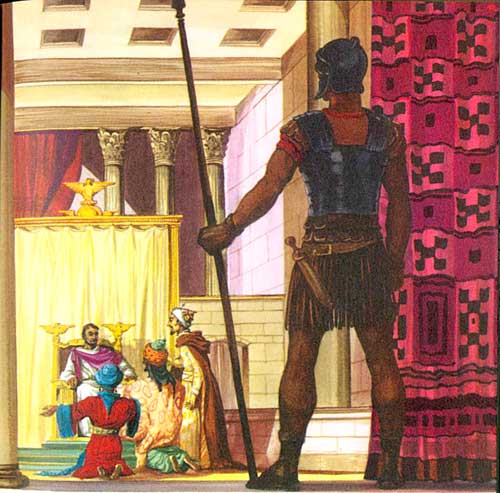
The wise men – and Matthew doesn’t tell us how many there are – come from “the East.” From Asia, Persia, Babylon. From the place where hundreds of years earlier the people of Israel were held in captivity by their conquerors. People from “the East” are the enemies of the people Matthew was writing to. Yet even these people see something important in the birth of this child. These people can see it in the world around them – in a star, in a wonder of the natural world. Everything points to this birth as something miraculous, something awaited – the ultimate “aha!” moment – the key interpretation that unlocks the meaning of the dream that everyone has been having.

The other theme in Matthew’s story is that of Herod, the frightened, the powerful, the violent. Matthew is writing to a Jewish audience, and here he depicts Herod, the leader of the Jews, as reprehensible and cruel. Herod is the one who does not dream. Herod is the one who wants no interpretation of the world around him other than his own – that it is a world completely under his power and authority. Soon after this passage, of course, he looks for the baby Jesus, and when he can’t find him, he kills all infant boys. Herod’s world is the world of ultimate rationality, ultimately ruled by fear.

Our two readings from the Old Testament – the passage from the prophet Isaiah and Psalm 72 – tell us what all the dreams point to. They tell us what Matthew had in mind, when he described Jesus as the true king and Herod as the false one. God’s vision for the world has always been one of justice, one of abundance, one of mercy. This is the light God shines on all the world – all the peoples – not just the ones who came out of Egypt as “God’s chosen people.” The kings who rule as God would have them rule defend the needy and rescue the poor and crush oppressors.

Given human nature, it is likely that there will be more people like Herod in this world, people who get power, and fear loss, and take revenge by shedding blood. But lessons like these let us know that we are not alone in condemning that way of doing things – that even people who we thought were our enemies yearn to live in peace and prosperity – that peace and light and justice are not only vague dreams but the means by which we interpret what is going on around us, even now, even today, “as the day dawns, and the morning star rises in our hearts.”[1]


[1] 2 Peter 1:19