Saturday, July 5, 2014

Who's in charge here?

Proper 7-A; June 22, 2014
Genesis 21:8-21

Psalm 86:1-10, 16-17
Matthew 10:24-39

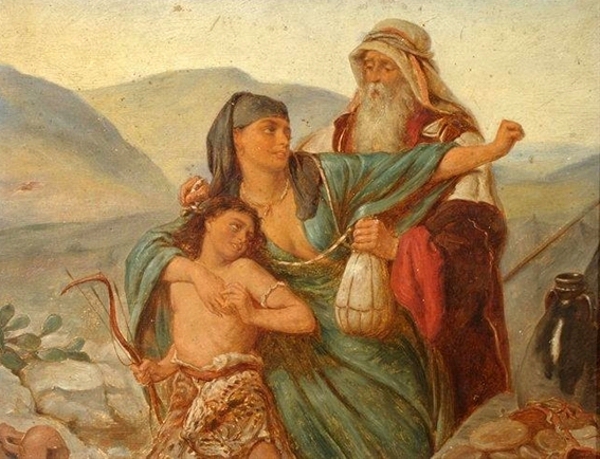
Because of his wife’s jealousy of the “other woman,” Abraham casts his first-born son into the wilderness to die. Hagar, the Egyptian slave woman who is the child's mother, has run out of food and water. She lays the exhausted, parched and famished boy under a bush, and says, to no one, for there is no witness to this act, "Do not let me look on the death of the child." She then cries aloud and weeps.

This could be a scene from South Sudan, from the Mexican border, from Syria, or from countless desperate places on our planet today, where mothers and children are abandoned by family, by warring governments, by economic forces beyond their control, and sent out to many kinds of wilderness to die. Friday was World Refugee Day, and a good thing, too, because I hear that today there are more refugees than at any time since the end of the Second World War.

If the day's Gospel lesson reflects Jesus’ “family values,” it does not fare much better. "I have come to set a man against his father, and a daughter against her mother, and a daughter-in-law against her mother-in-law." Jesus declares. "One's foes will be members of one's own household. Whoever loves father or mother more than me is not worthy of me."

This passage comes from a section in the Gospel of Matthew concerning discipleship: what does it mean to follow Jesus? What would it look like in my life, the disciples are asking themselves, to take part in the breaking in of this kingdom of heaven? What does it mean to take up my cross, to lose my life, to understand God not as the bringer of peace but as the wielder of a sword?

As important as family is to us today, our modern ears cannot hear it quite the same way as Jesus’ followers would have. We moderns are all about “ME,” about self-actualization and self-realization. We strike out on our own, we value independence and self-reliance: the Lone Ranger, the pioneer on the frontier, the corporate raider, the “Army of One.” But in the world in which Jesus lived, you were not an individual apart from your family. Your family gave you your identity, gave you not just your name but your place in the community and in the world, and your family protected you from that world. Your family was a good thing, a precious thing; you didn’t just strike out on your own. Jesus isn’t some 1960s hippie cult leader telling you to tune in, turn on, drop out, from a family that oppresses, abuses or bores you.

There were plenty of bad things in first century Palestine, plenty of things that Jesus might exhort you to leave behind, but the family was not one of them. The Romans were bad, because they were an occupying army in your homeland. The temple authorities were bad, because they colluded with the Romans in exchange for privilege and protection. The civil bureaucracy was bad, because it taxed the people nearly to death. Indeed, death and fear were the operative social norms. The family was the refuge from all that. No one could survive without a family.

So when Jesus says, “Follow me,” he is asking the disciples to leave behind one of the few institutions in society that works. Jesus’ call upsets every apple cart there is, and then he says, don’t worry. Don’t be anxious. Consider the lilies, remember the sparrows. The kingdom of heaven means the whole world is about to be re-ordered. Everything will be uncovered. There will be no more secrets, no more power brokers, or back-room deals. This news is so good that it must be shouted from the rooftops – no matter what the consequences. No matter how many authorities you anger, no matter how many armies they unleash. God’s kingdom HAS to challenge this kingdom, and even the blessed and good family, the loving parents, the bonds of affection and kinship – even these can get in the way of this truth of God which cuts like a sword. The new thing which God is doing is even deeper, even more important, even more powerful that the deepest, most important and most powerful parts of our lives, the parts of our lives that make us most truly human. God is a sword which pares away even our relationships, our kinships, our families.
Where is God taking us with this confusing, and maybe even terrifying, lesson? Is discipleship some sort of desert wilderness? Are we called to be like Hagar and Ishmael, stumbling around until the water runs out, cut off from family and security and hope and the future?

Look again at this astounding story of Hagar and Ishmael – and God. Even though God has apparently blessed the dismissal of the two into the wilderness, God will not let them suffer. The voice of the angel of God raises Hagar’s hopes, and promises that even this discarded son of Abraham will be the father of many nations. Even these two hopeless creatures, these outcasts and discards, this tiny remnant of a broken family will have a great future in store. Abraham may have cast out Ishmael but God stayed with him.


If Jesus calls us as disciples to turn away from even the good parts of our lives, if they distract and keep us from the gospel, it is because being a disciple leads us into so much more. We see this broken world now as Jesus sees it. Freed from our own particularity, we can act as perhaps Jesus would have us act. We can even take our families with us. We can see the Hagars and Ishmaels of today, in the countless desert places, the violent streets, the lonely corners. We can resolve to be that angel of God who shouts from the rooftops that it doesn’t have to be this way, the angel who brings God’s gifts of water, sustenance and hope to a world that too often cries in despair.

Proper 29 C     Nov. 24, 2013
Jeremiah 23:1-6
Canticle 16 – Luke 1:68-79
Colossians 1:11-20
Luke 23:33-43

One of the founding stories of our democracy is “no taxation without representation.” It is hard indeed, after all these years, built on stories like that, to get our American heads around the Sunday of “Christ the King.” Many Christians now call this day “the Reign of Christ,” which seems to downplay the patriarchal tint to the word “king,” but the monarchy is still there: we small-d democrats and small-r republicans have no intention of living under anybody’s “reign” – monarchs reign; in a democracy, our leaders govern with the consent of the people. We are citizens, not subjects, and even at times like this, when our democracy seems a little bit lumpy and not working as well as we would like, we’re not going back to be under anybody’s “reign.”

Yet our most frequently used prayer goes like this: “Thy kingdom come. Thy will be done, on earth as it is in heaven. Give us this day our daily bread, and lead us not into temptation.” No matter what our system of government is, apparently the best way we can describe what the world should be like is that it is under the reign of God – a reign under which all basic human needs, like that of daily bread, are met, where “structures of domination and subjugation [are] overcome… [where] all dwell in harmony with God and each other[i]” beyond the temptation and corruption of evil.
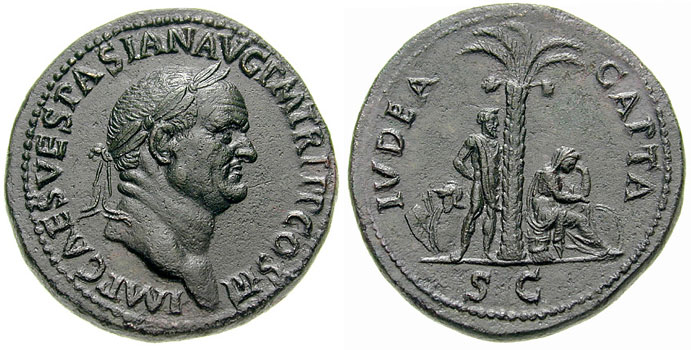
If we Americans live in a democracy, yet with this memory of monarchy, the people of Jesus’ day found themselves living in an unjust monarchy, yet with a memory of democracy – or at least of republican government. They remembered the rule of law. They remembered when their wretched taxes did not go to support an imperial military force that imposed order whether it was lawful or not. The days of Caesar Augustus, as the evangelist Luke is so keenly aware, are the days of the first emperor, the emperor who wrenched power from the elected consuls, now no more than the shell of republicanism. “All the world is at peace,” Caesar declared. “First victory, then peace.” The people longed for order and for peace. They longed for a society in which they could safely earn their daily bread, a society which kept at bay for the forces of chaos and disruption. But under the emperor, who needed all those rumors of war to stay in business, peace came from a permanent military. Peace came at the price of crippling and permanent taxation from which there was no hope of relief. Peace came at the price of the erosion of the rule of law. Peace came at the price of justice.

The Jesus mocked as “the king of the Jews” has no power to impose anything like the peace and order of the Roman Empire. By the time this Gospel is written, decades after anyone alive had witnessed that crucifixion, people were beginning to understand what this “reign of God” meant – what this alternative kingship was about. Jesus went to his death talking about a different kind of world order. In his life and in his death, Jesus ‘[grappled] with the disorders of injustice, suffering and death. The darkness of death,” writes Biblical scholar Walter Brueggemann, is pushed back one emergency at a time.” Over the course of his life and in the manner of his death, Jesus demonstrated to ordinary people – like us – that he knew just what they were going through, that he stood with them, and us, and that most importantly he WITHstood the worst that lawlessness and chaos could dish out.

People knew that Luke wrote the truth about Jesus. They knew it because the people who stood up for
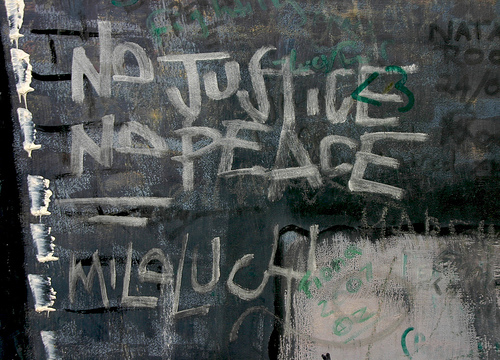
them, and with them – the people who were willing to go to their deaths in place of them, were the people who believed in this upside-down kingship of Jesus. The people of Luke’s day knew they could pray to the Emperor all they wanted, but there was no bread without justice, no peace without justice. The imperial army could be powerful and rich, but the people still suffered from want and lived in fear. The people of Luke’s day began to follow “the servants of this new king. [These] practitioners of this newly ordered world” took their leadership public. When Luke told this story of standing at the foot of the cross, of hearing in Jesus’ last words that he was still turning the world around, it gave people courage that they could do that too, in their own day and in the face of their own challenges.

This day of Christ the King is for us, citizens and subjects alike.


[i] Rosemary Radford Ruether, in Sexism and God-Talk, quoted by Suzanne Guthrie in http://www.edgeofenclosure.org/reignofchristc.html

Monday, June 30, 2014

Creation, Trinity and the Celtic Knot

Trinity Sunday June 15, 2014

Genesis 1:1-2:3
Ps. 8
2 Corinthians 13:11-13
Matthew 28:16-20

Today we read the beginning and the end: God as Alpha and God as Omega. “In the beginning God created heaven and earth,” and “Lo, I am with you always, even to the end of the age.” What do these texts say to us about the nature of God? The activity of God? The being of God?

There certainly are literal interpretations of these texts, and of the understanding of the Trinity as a God with three faces, or three bodies – that Old Guy, Young Guy and a Bird image that you know is somewhere in the recesses of your mind. “God in Three Persons, Blessed Trinity” IS hard to grasp, as you will hear in this story of the little girl and her mother, talking about God.

Is God big? the little girl asked. Yes, said the mother, God is very big. Is God everywhere? asked the girl. Yes, said the mother, God is everywhere. Could God do anything he wanted to do? The girl continued her line of questioning. Yes, said the mother, getting a little concerned about where this might be heading. God loves us, she assured her daughter, and wants always to be near us. Could God get into my cup? the little girl asked. Well, I suppose so, said the mother. The little girl triumphantly clapped her hand over the cup. Got him! she shouted.

Theologians love to write about the Trinity, and – surprise! – they use stories that are a lot more complicated than that one of the free-thinking little girl and her more conventional mother. One theologian uses the metaphor of water for the Trinity: God as the source, as the spring and as the live-giving stream.i It really makes more sense to talk about God as activity, creating and enlivening and nourishing us all, all the time.

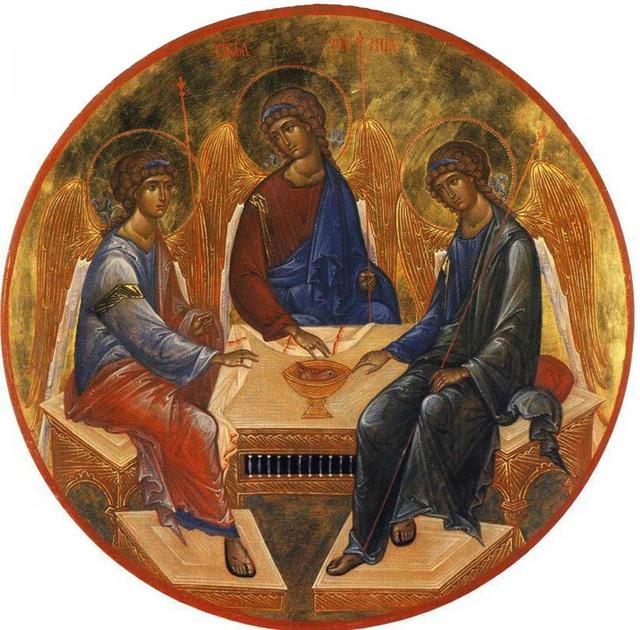
Ancient theologians thought of God as a dance. The Greek work that describes how God the Trinity relates to God’s self is parachoresis, dancing through. The reality of God is that God is dancing among God’s self, bubbling and babbling, twisting and turning, and all the while creating life, reaching out to creation in love and reconciliation, and breathing on it life-sustaining spirit.

Genesis tells us the story of creation, of how God created not only heaven and earth, fish, birds and animals, but some other creatures as well, creatures made in the image of God. God created them, humankind, male and female. This is the image and likeness of God. This collective body of humanity, this maleness and femaleness, tells us something about what God is like. Certainly not everything about us is God-like, for we know the human propensity to pull away from God, from our God-nature. Sometimes we do bad things.
But what is there about being human that draws us to God? In thinking of God as activity, what activity draws us closest to God? How can we behave in a way that could be described as God-like? Surely that is love. And how do we love? In relationship, in community, even if it is only a community of two. And are relationships, even loving relationships, simple? No; they are many-faceted and difficult to describe in their entirety. You certainly can’t put a face on a relationship and say, there, that sums it up, because there will always be something else about the relationship, or the person you love, that will bubble up and surprise you in a new way.

That is where the language of the Trinity came in: from the need Christians had to describe just what this relationship with God was about. Christians had to find words for their experience of God, especially God in this new way: God had become human – begotten – because God loved us so much that God wanted to save us from ourselves. God did not want us to keep pulling away – but how could God be up there and down here? It got too complicated to think of God in only one way, or as only one thing, for now God was doing many more things. Hence: God as the dance, the spring of living water, the fount of every blessing, comforter, Incarnate Word, mighty source, Ancient of Days, immortal, invisible, only-wise, silent as light. In the beginning, and with us always, even to the end of the age.

Read this prayer along with me. It was written down by someone in 19th century Scotland, but it is much, much older than that. This “Rune before Prayer” is really an invitation to pray. When words were not enough to describe the reality of God to the believer, we have Celtic Christianity to thank for just piling on more and more words, and because they did, we are the richer.


I am bending my knee 
In the eye of the Father who created me, 
In the eye of the Son who purchased me, 
In the eye of the Spirit who cleansed me, 
In friendship and affection. 
Through Thine own Anointed One, O God, 
Bestow upon us fullness in our need, 
Love towards God, 
The affection of God, 
The smile of God, 
The wisdom of God. 
The grace of God, 
The fear of God, 
And the will of God 
To do in the world of the Three, 
As angels and saints 
Do in heaven; 
Each shade and light, 
Each day and night, 
Each time in kindness, 
Give Thou us Thy Spirit.  ii

i. David Cunningham
ii. Ancient Celtic prayer collected by Alexander Carmichael (1832-1912), published in Carmina Gaedelica (Edinburgh: Floris Books, 1992)


Proper 28 C     11/17/2013
Isaiah 65:17-25
Canticle 9
2 Thessalonians 3:6-13
Luke 21:5-19

I bet you have heard of the “new atheists” – scientist, journalists, philosophers who are on their own kind of crusade to say that religion, spirituality, belief in a higher power is all superstitious bunk. One journalist[i] I read interviewed and read several of these “atheists” and noted that their “creed” was in fact kind of that: a dogmatic system for which they were very evangelical. The world is in danger from religion, some atheists proclaim; all religion tends toward fanaticism. Religious people are dupes; nothing can be proven. It is all very logical, the journalist noted.

And in that logic, the journalist noted, is the rub. Taking a “logical” approach to something as vast as the meaning of existence leaves people a little cold. As journalists do, he contrasted the atheists with a Christian church – and as journalists do, it was a big mega-church with an evangelical rock band performing a concert/worship service/altar call to 500 teenagers. However logical, however intellectual, the journalist noted, the new atheists can’t draw a crowd or build up enthusiasm like the direct, emotional appeal of that Christian evangelical crowd.

Our lessons today certainly are fodder for the new atheists’ scorn. Endtimes, prophecies of doom AND abundance, talk of salvation and the saving of souls would just be proof of our illogicality and foolishness.
But like the young evangelicals headed to an altar call to the strum of electric guitars, the appeal of our
lessons today is in their very big-ness. These lessons remind us that we are part of grandness of God. We are not small, insignificant blips; we participate in God’s great creative adventure. The prophet Isaiah, who never minced words when he told the people of Israel how badly they behaved, now sings lyrically of restoration, of what blessings the people will receive when they return, as promised, to their home in Jerusalem. Jesus’ words bolster people whose lives are on the line, who face imminent imprisonment and death. The people to whom these sayings are directed are not interested in logical arguments, small helping hands, or social niceties. They are involved in a great cosmic drama, and God, our God, is right there with them. To be called by God to God’s mission means being part of the bigness of God.

We don’t have to be prophets to know that there are lots of changes going on in Episcopal Church nationally and locally. I have heard talk at many parishes, including this one, that people are few, resources are scarce, and that the end is near! Such talk demonstrates about as much trust in the mission of God as those “new atheists” admit. Thinking small, thinking shrinking takes everyone down a road of no return.

I’ve said it before and I’ll say it again: the Episcopal Church, and this parish in particular, have a future, a sustainable future. Our future is in participating in the bigness of God’s mission. Our future is thinking and acting in ways that might be different than in the past, in partnering with other churches and non-churches, on the exciting work of connecting God’s mission with the needs of our community, but also on the practical ways we can be sustainable and steward our resources collectively for a future role in God’s big mission
It is the Sunday of the pledge ingathering. We are giving today – giving who we are and what we have, and nothing that we give is small. No matter the size of our pledge, our giving, here or anywhere else, our gifts are part and parcel of the greatness of God, of the bigness of God’s mission. We give back because we have been promised big things – because we can participate in things that are big enough to be worthy of our gifts – because what we give here inspires and encourages all of us to go out into that great and immense mission of God. It is not logical, it is not intellectual, and it certainly can’t be scientifically proven, but it is true. It is a great adventure. It is the cosmic journey of all creation. Participating in this mission is what it means to be blessed, what it means to gain our souls.


[i] Gary Wolf, “The Church of the Non-Believers,” Wired, November 2006  http://www.wired.com/wired/archive/14.11/atheism.html

Saturday, May 17, 2014

God is not God of our debt or our death, but a God who gives us a living hope.

Proper 27C
Nov. 10, 2013
Haggai 1:15b-2:9
Ps. 145  
2 Thess 2:1-5, 13-17
Luke 20:27-38

Years ago I knew people who claimed with pride to be on Richard Nixon’s enemies’ list. We could laugh about it, because, other than our beleaguered and slightly paranoid 37th President, such lists seemed far out of character with American life.

But it strikes me now, in these rather dark days after 9/11, that feeling beleaguered and paranoid has become part of the character of life, here in America and just about everywhere else. I’m not talking about partisan politics, nor the Bill of Rights, nor even about the NSA listening in on all of our phone calls. What I am talking about is the pervasiveness of the feeling – the world over – that we must be afraid – that we have got to ramp up our security – that the barbarians are not only at the gate but they seem to have snuck into our backyards while our heads were turned. Of course, bad things do happen, in random and terrifying ways, and this fear has seemed to seep into the very air we breathe, the water we drink, the conversations we have with friends and strangers. This really is not just about the US – this is a global phenomenon. What nation do you think has the most comprehensive system of surveillance? Of spying on everyone, friend and foe? It is Great Britain, which “is estimated to have more closed circuit tv cameras than any other country, including China. They are found in every store, railway station, school or bus – one for every 11 people[i]…” Security cameras seem to be, perversely, a bit like the saints of God: you can meet them in school or in lanes or at tea, in church or in trains or in shops or at tea … but, do they really make us feel any safer? Or does having them make us want more of them?

It’s the comprehensiveness of it all – the global character of it – that gives us a clue, I think, to the empire of fear and dominance we read about in the Gospel. The Roman Empire is not in the background of the story, but the foreground, as people who read the Bible closely point out to us. For example, Luke begins his story of the birth of Jesus by telling us, “In the days of Caesar Augustus a decree went out that all the world should be taxed.” Front and center. Caesar Augustus. The Empire and its demands reached into every corner of the known world, no matter how dusty, no matter how poor.

The Gospel of Luke is curious: at times, it seems to be eager to point out that this new religion of Christianity can co-habit accommodatingly within the Empire. Luke picks up on sayings of Jesus like “render unto Caesar what is Caesar’s.” But if Luke reminds his readers, and us, that the people were under the thumb of the imperial domination system, it is really to shout from the rooftops that that kingdom of death did not, and would never, have the last word over their lives, over their communities, indeed, over the whole world. Our God, Luke remembers Jesus saying, is not of the dead but of the living, for to God, all children of the resurrection are alive.

In this story today, Jesus does seem to get into an obscure doctrinal debate among two “parties” of Judaism: the Sadducees and the Pharisees. The Sadducees were out of the mainstream of the Judaism of Jesus’ day; they chose to follow only the Torah – the first five books of the Bible. The mainstream of Judaism included the psalms and the writings of the prophets as sacred as well – writings that took in a much larger view of the world and of God’s activity in it. Mainstream Judaism understood death and resurrection. They had lived through terrible times, through the exile in Babylon and the return to a destroyed Jerusalem. The prophets helped them understand God’s actions in history and their own, human failures with in God’s history. The psalms gave them songs to sing – songs of anguish and lament, but songs of praise for all of God’s generosity and mercy. Mainstream Judaism knew what it meant to break that old Torah covenant, to walk in the valley of the shadow of death, and yet, by God’s most gracious, loving and forgiving hand, to be brought back to life.

So Jesus gets into a debate with the Sadducees not about the legal points of marriage but about their understanding of the future, and of how God works in this world. If there is no resurrection, as the Sadducees say, then death wins. There is no justice, only vengeance. The Roman Empire wins. The surveillance cameras win. It is a tit-for-tat endless cycle. God’s justice supersedes what humans impose, out of fear or need for control. God’s justice takes every human hope, and exceeds them with mercy and abundance.

The story of this encounter between Jesus and the Sadducees, as written down by Luke near the end of the
first century, vividly reflects what was going on in those days. People living in Israel around the year 100 would remember Rome’s extraordinarily violent response to the Jewish Revolt about 30 years before. It was the war during which blood literally ran in the streets of Jerusalem and the Temple was destroyed. Even today you can see how proud the Romans were of their victory over these conquered people, in the Arch of Titus, depicting the legions carrying off the spoils of war from the looted Temple. For the thousands upon thousands of Jewish dead to remain dead, after such devastation, would mean that the Romans would indeed control the world, that their victory would proceed any imposition of what they would call “security” or “justice.”

But if Jesus and his followers understood whose world this really was, whose justice truly reigned, then death and its domination system would never win. If Jesus and his followers understood resurrection as the restoration of God’s justice, of God’s abundance, of God’s mercy, then that was what it meant to say that God was the God of the living.

It is very tempting to buy the world’s line: there is not enough to go around. You are not safe enough, you don’t have enough money, things will never work out, death is the end. There aren’t enough people in our pews, and we can’t pay our bills. But people who believe in the resurrection know better. We know that God is not God of our debt or our death, but a God who gives us, and the generations who come after us, a living hope.

To be a spectator of Reality is not enough

Proper 26C & All Saints
Nov. 3, 2013
Isaiah 25:6-9
Psalm 149
Ephesians 1:11-23
Luke 19:1-10

What if it doesn’t really matter to God how nice we are?

On the one hand, that would be a terrible thing. Being nice to each other smoothes over a lot of problems. Being nice greases the wheels of a squeaky society. It doesn’t cost us much to be nice to strangers, to be courteous while we wait in line for coffee, or behind some who has a seemingly bottomless grocery cart, or who cuts us off in traffic – in any number of places in everyday life it makes everyone’s existence so much better if we are nice.

On the other hand, I don’t think God chooses saints because they are nice. In today’s Gospel story, Zacchaeus was not nice, and no one (except Jesus) was nice to him. Zacchaeus was like someone else we know:

Oh! but he was a tight-fisted hand at the grindstone, Scrooge! a squeezing, wrenching, grasping, scraping, clutching, covetous old sinner! Hard and sharp as flint, from which no steel had ever struck out generous fire, secret, and self-contained, and solitary as an oyster.[i]

These are popular characters in our imagination, these Scrooge-Zacchaeus types. Not nice at all, but dramatic, meaty, attention-getting.

Like being nice, there certainly is a lot to be said for spiritual discipline, for the practice of prayer, of meditation, of communion with God. But what if, like being nice, none of that was what counted in the clutch? What if God works through – soundrels? People with no discipline? People who can’t keep it together? People who are greedy, self-centered, and, as Dickens said, “solitary as an oyster?” In other words, people like us?

What if, on this All Saints Day, God reminded us that we did not need a finishing school education to get into heaven? What if God took us all – nice and not-so-nice, short-tempered and generous, poor and, even, rich?

The story of Zacchaeus is the story of conversion: dramatic, immediate, shocking and thorough-going. Zacchaeus’ only preparation for this conversion was his curiosity about Jesus, and for Jesus this was enough: salvation came to Zacchaeus. The one who was the furthest out, the biggest sinner, the least likely candidate, the most lost, was the one Jesus held up as the model of salvation. The one who had hoarded his wealth, who had stored up his many ill-gotten gains, is the one who now finds his true wealth in giving it all away. No longer is his game about preserving his own self, but about serving the redistributive justice of God.

What does it say about God that is it not the “nice” but the lost who matter? It says that we are back in the game. We don’t have anything to prove to God; we can’t possibly be good enough, and we can’t tell God anything that he doesn’t already know. But we can – wake up! The insistent demands of the kingdom of God are all around us, if we would but see. “To be a spectator of Reality is not enough,” wrote Evelyn Underhill, a 20th century writer about the spiritual life. What is demanded is participation: “… and for this, a drastic and costly life-changing is required.”[ii]

What does it say about God if people like Zacchaeus, like Scrooge, even, are the people God uses to bring about his reign? To help return to the world to the way God created it to be? What good news indeed that all of us could be saints, that all of us could be bearers of the Good News, that all of us could leap down from our sycamore trees, that we would divide up our store of hoarded goods, that Jesus would come to our house for dinner, and we would all have a very good time?


[i] Charles Dickens 1812-1870;  A Christmas Carol
[ii]Evelyn Underhill 1875-1941; Mysticism

Stewardship Sermon # 2: Help, Thanks, Wow

Proper 25-C 
10/27/2013
Joel 2:23-32
Psalm 65
Luke 18-9-14

You might think that this would not be the best gospel to read during stewardship season. The Pharisee, who is good, who tithes, who prays, who does the right thing always, seems to be outshone, in Jesus’ estimation, by this grubby tax collector.

Remember that if you take literally the list of religious do’s and don’ts in Jesus’ day, tax collectors are by definition sinners: the work they do – like the work done by shepherds, fabric-dyers and other necessary members of first century Israel – automatically makes them sinners, no matter how nice or good or faithful or generous they are in and of themselves. So it really is kind of shocking to the first hearers of this parable – part of Jesus’ pattern of reversing expectations every chance he gets.

And despite its being read during stewardship season, this parable is only tangentially about money. It’s really about prayer, about how we pray, and why we pray.

In her dandy little book, Anne Lamott says prayer is about three things: Help. Thanks. Wow. Today, our lessons are about WOW.

First of all, there is nothing wrong with the Pharisee. The world would get along much better with more people like him – no doubt. But it seems like the critical point Jesus is making here is that the Pharisee follows the rules maybe a little too closely. He’s got it all together -- maybe to the point of being able to go it alone, maybe even to go it alone without God.

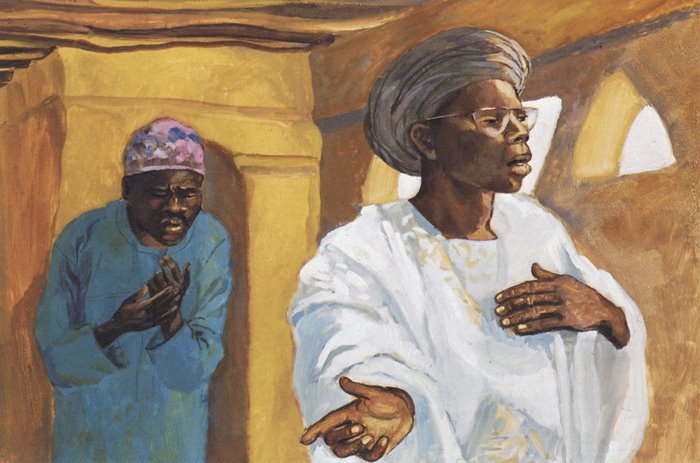
If we look at it this way, the contrast with the tax collector becomes clearer. If the tax collector has it “up” on the Pharisee, it’s in the way he realizes he is inextricably tied up with God. He knows that it is only by the grace of God that he can get by. The tax collector is on intimate terms with all of Anne Lamott’s prayers: He’s real big on “help,” and when things work out (even when he thinks they won’t ever), he’s got “thanks” all over. In fact, his life is one big “wow.” I get the sense he is just astounded to be alive – him in his wretched, inevitable outsider-ness.

In all of those prayers – Help, Thanks, and Wow – the tax collector knows he is completely dependent on the grace of God, and THAT is what the Pharisee can learn from this person he would never have the occasion to meet. In fact, the Pharisee would learn that his prayer is tied to the tax collector’s prayer in one great loop of interdependence – the grace of interdependence. Grace is always around, before and within us – and grace is always something that God wants us to respond to. The Pharisee’s tithe and righteous prayers are not things he can make on his own: they are responses to the grace and goodness of God. And if the Pharisee is under the illusion he can do this all on his own, then he needs the tax collector, who gives thanks to God for every breath he takes, to realize that all of our lives – indeed our common life – comes always and only from the grace of God.

Our two lessons from the Hebrew scriptures are indeed about the prayer that can only be “wow,” about the glory and grace of God we can see, if we only pay attention, if we respond with that awareness of our interdependence, and interconnectedness. It’s the “wow” that we would never believe could come true if we thought we had to do it all alone, by ourselves. It’s the “wow” we are aware of when we respond to the grace of God.


And so I guess this is a stewardship lesson, and one of the things we can consider when we praying about what financial contributions we will make to this parish, and how we will contribute our time and talent to our common life. Like “help, thanks and wow”, like the Pharisee and the tax collector, we are tied together in this grace of interdependence. What would it mean, if we did more than keep the status quo going, if we did more than just keep this parish together? If we lived into that “wow” factor a little more?

The Stewardship Sermon: What is God calling forth from us so that we can fully become this parish that we say we value?

Proper 24 C
Oct. 20, 2013
Jeremiah 31:31-34
Psalm 119:97-104
2 Timothy 3:14-4:5
Luke 18:1-8

You do know the story of the man whose house was flooded. First he climbed on his furniture, then he climbed to the second floor of his house, then he climbed out a window on to the roof. All the while he was praying. I know God will save me, I know God will save me, he said over and over again. When he was still on the first floor of his house, his sister called: Get out, she said. The flood waters are rising. I’ll come by and pick you up. No, no, he said. I have been praying. God will save me. You’re nuts, she said, but have it your way.

When he was on the second floor of his house, the state troopers came by in a motor boat. They had a megaphone. Get out, they said to him. The flood waters are rising. We’ll pull over to the window here and help you into the boat. No, no, the man said. I have been praying. God will save me. Sir, the troopers said, sir. We urge you. Get into the boat. We can’t wait much longer here. The flood waters are rising. We’re risking the lives of other people we are saving. Go ahead, the man said. God will save me.

When he was on the roof, clinging tightly, as the wind whipped around him and the waters rose, a helicopter flew over heard, and a Coast Guard rescue worker was snapping on his harness and getting ready to drop to the roof and pick up the man. Hold on, the Coast Guard shouted, we’re sending our most experienced and strongest sailor down to pick you up. No, the man shouted back, and waved his arms energetically. I am fine. God will save me. What, the rescue workers in the helicopter shouted. We can’t hear you; the wind is picking up. Go on, the man signaled to them, go on. Finally, even the helicopter had to fly away, and there was the man, clinging to his roof, when the wind and the waves overcame him and he drowned.

The man gets to heaven, and he is not only dripping wet, but he is mad. He pushes through the pearly gates and demands to see God. He shakes his fist and shouts, So where were you? I waited, I prayed, I waited some more, and look where it got me!

What do you mean? God said. I sent your sister by, and you wouldn’t get in the car. The state troopers were right on it, and still you didn’t get in the boat. And the helicopter – oy. What have I told you? Pray always, and do not lose heart – but my child, also, do not lose your head.

For the two and a half years I have been here, we have been like the man in the house with the waters rising around him. Not in every aspect of our life, of course – we have had successes, we have appreciated each other, we have done some terrific things, we have served God and the community. But we have had a running deficit of $30,000 in our operating budget. Even though we have tried to manage this deficit, the bills have had to be paid, and the various reserve accounts, over the past decade or so, have run out. The only thing left are the funds from the sale of the most recent rectory – and spending them at the rate we are going means – well, it’s not good. One definition of crazy is doing the same thing over and over again and hoping for different results. For the past several years, the vestry has budgeted this hefty deficit, told you all about it at the Annual Meeting, and expected the deficit miraculously to go away. It has not.

With much prayer and deliberation, with considerable time and attention, the vestry and I have come to the realization that this deficit is a spiritual problem. It blocks parish life. It makes it difficult to stand up here at stewardship time and ask you to give to mission – to give to things that make a difference in people’s lives -- when we are really desperate to get to you pay for the maintenance of this deficit. It makes it really difficult to invite new people into our community. It’s hard to preach about the abundance of God when we are not making ends meet.

Yesterday, the vestry met as the Finance Committee of the Whole. We spent three hours together listening to each other, sharing feelings and thoughts, digging into the reality that the budget we have been presenting to the congregation for several years at least is NOT the budget you want to pay for. We came to the consensus that we are going to reduce our parish budget in 2014 – perhaps by $30,000, perhaps by less, but certainly significantly. We are going to live within our means.

Let me stress that this is not negative “solution” to a “problem.” We cannot get to abundant life by doing less. Jesus did not come to earth just so we could have “less death.”

This (A) is where we are now. It doesn’t matter how we got here, or what might be to blame. What matters that we understand who we are right now, our assets, our abilities, the many things we have going for us, our considerable pledged income, our 65 generous pledging units, our building which is paid for, easy to maintain and for which we have a surplus of capital funds. We could go on and on about what a great parish this is. 
This is the reality of (A).

This (B) is where we want to go. This is the future we want to live in. This is our imagined life abundant. This is the parish that can live within its means. This is the parish that gives away twice as much money as it spends on its own maintenance. This is the parish that people join because here we do things that make a difference in God’s world. This is the parish that celebrates the beauty and wonder of God. This is the parish that is always stretching to reach those new places to which God is calling us, new ways to serve, new communities to transform.

What do we have to add to (A) to get to (B)? What do we have to do differently about our life and mission in order to make this parish sustainable into the future? For another generation?

Some of that arrow includes money, yes. But it also includes more information. Financial transparency. Accurate record-keeping. And an honest budget where we pledge not only to our common life, but to live within our means. Where we know we can respond generously when asked, when our time, talent and treasure can make a difference in this broken and needy world.

In our first reading, the prophet Jeremiah talks about the new covenant. There is always some controversy about that “new” covenant. Is God getting rid of the old Sinai covenant, the Torah, the ten commandments, all of Israel’s past? But look what happened to the Jews who came back from exile, whose return was promised by God. They were able to rebuild Jerusalem. They pulled together their old traditions and observances and customs and inhabited them in a new way. God was the one who called them back. God was the one who took the first step for forgive and forget. God was the one who wanted a relationship with them SO MUCH that he was willing to start over – to re-boot the whole kit and caboodle, to give these crazy people a new chance at a future.

The vestry might propose some drastic changes in how we spend our money as a parish community. We are not breaking with the past: we are building on where we are now, so we can take all these things that we love with us into the future.


This is the purpose statement of the parish as you wrote it in your parish profile in 2010. This is what you said you were about when you were looking for a new rector. I am going to hold you to this, to say that this says something important about who we are and what we value. This may not always be our purpose statement, but this is what we have. Does this statement describe (A) – where we are now – or (B) where we want to be in the future? Or is it some of both? What is God calling forth from us so that we can fully become this parish that we say we value?

Monday, January 13, 2014

Seek the welfare of this city

Proper 23 C     October 13, 2013
Jeremiah 29:1, 4-7
Psalm 66
2 Timothy 2:8-15
Luke 17:11-19

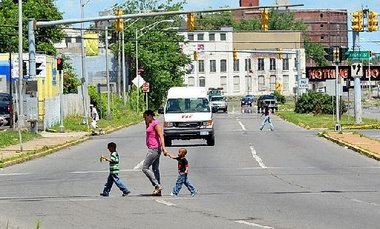
When I drive around a city like Syracuse, I experience a profound sense of dislocation. None of these places are like they used to be. Whole industries have just picked up and moved, leaving behind the communities of people – immigrants from somewhere else -- who moved here to work in those industries. Several years ago, my brother, who has had a good, United Auto Workers-guaranteed job with Chrysler Corporation for many years, moved to Indiana, to work a last few years in order to keep his pension intact. When I go to Armory Square, I remember it as kind of seedy but industrial. The factories on West Fayette Street were busy places. People living on the West Side could walk to work. To work. I’m kind of shocked to learn that the zip code where I grew up – 13204 – is one of the poorest in the nation. As we survey the urban, industrial landscape in America, you could describe it all as an experience of exile, from decades of stable jobs, stable families, stable neighborhoods.

In our Old Testament lesson, we are in the land of the exiles. Jeremiah is again preaching to the exiles in Babylon, those who have been uprooted by force, by the violence of an invading army, and transported to a foreign land, the place, as we read in the psalm of exile, Psalm 137, where the people could not conceive of finding God: “How can we sing the Lord’s song in a strange land?” But Jeremiah, the prophet who told these people that their own faithless behavior caused God to send them into exile – this same Jeremiah now comes back at them with a word of hope.

Ok, he says, there you are in that foreign city, that unrecognizable place, where you have been thrown into exile. But that is the very place where God wants you: where God wants you to settle down, to build homes and gardens, to have families and children, to live and prosper. Seek the welfare of that very city where you now live – not the city of your romantic, longed-for or nostalgic past. Not the city where things used to be so good. Seek the welfare of THIS city. Pray that God bless THIS city. For it is in the welfare of THIS city that you will find your welfare.

The Hebrew word for welfare is shalom, a word used 397 times in the bible! It is translated into English in many ways, reflecting the complexity of how it is used in Hebrew. Shalom means peace, weal – as in “Commonweal” or “Commonwealth” – it means completeness, to cause to be at peace, to make peace, to be at rest, at ease, to be secure, or safe, or to prosper, to be whole, to be perfect, to be victorious. It is at the heart of the word “Jerusalem” – salem. It is the same as the Arabic word, salaam. If we move into Greek, the language of the New Testament, shalom might be understood as what Jesus meant when he said “the kingdom of God:” the time and place when the justice, mercy and love of God prevail.

To work toward that vision of God’s shalom in this place is to work toward nothing we have seen before. Not in Syracuse, not in DeWitt, not at St. David’s. Jeremiah’s prophecy is that we are all in new territory now.

When the city of Jerusalem was invaded, and the leaders and people carried off in captivity to Babylon, there were some Jews who stayed behind. They lived in occupied territory, and they really lived there. Meaning they intermarried with the occupiers, and in the eyes of the exiles in Babylon, they were traitors. Since they did not suffer the pains of exile, and “collaborated” with the enemy, they were pariahs. When the Jews came back from Babylon to rebuild Jerusalem, they treated these stay-behinds no longer as kinsmen, but as enemies. They were the Samaritans. Even the passing of hundreds of years could not erase this animosity, and as late as the days of Jesus, faithful Jews could barely spit out the name, “Samaritans.” The name was short-hand for everything disreputable, bad and unclean.

What a shocking story then Jesus tells, about lepers and gratitude. This is not just a story about how polite people say thank you (although this IS one of the appointed lessons for Thanksgiving Day). This is a story about God’s shalom, God’s wholeness, God’s health. About who is the citizen of God’s commonwealth. The only one who is truly whole is the one the other nine despised, the one marked by some as unclean forever. The one forever “other” than Jesus’ own people, the people of the covenant, the people who thought they were automatically assured of God’s grace.
The peace of God, then, is, amazingly, caught up in the peace of the other. Our welfare is inextricably tied up with the welfare of complete strangers. Our wholeness is wrapped up in the wholeness of our enemies. Our health is entwined with the health of people we consider “beneath us.” When we walk out of these doors, we pass Springfield Gardens, we go down South Salina Street, we’re on West Fayette Street. Our future will look nothing like our past, and this is where we plant our garden.