Wednesday, January 11, 2012

Caught in the sacred geography


Epiphany 1 B    January 8, 2012
Genesis 1:1-5; Psalm 29
Acts 19:1-7; Mark 1:4-11

I have really had enough of all these primaries – or to be more precise, I have really had enough of the ceaseless “news” coverage of all these primaries. Republican or Democrat (and this thought is not original to me), they duke it out in the least representative parts of our nation: Iowa and New Hampshire, places where the unemployment rate (quite low) and the demographics (quite homogenized) make them decidedly different from the rest of the country, where the rest of us live in economic uncertainty and rich, if sometimes contentious, diversity.

The concerns these politicians play out in these small states are, however, the concerns of the center, of the political and economic elite of our society. It’s a proxy dance for who will stay in power, and at the end of it all, will those who will have to live with the consequences of all these positions and policies and politics and punditry, have much of a say in how it shakes out?

If we were telling this story in first century Palestine, say, this story the presidential primaries would be a story about Jerusalem, here, the place where the power brokers reside. In first century Jerusalem, we find the Temple, the center of Jewish religion, of the elite, the place paid for by the taxes all Jews, rich and poor, have to pay. Jerusalem is also the political center, where the leaders of the occupying Roman empire and military reside, where they hold court, where they plant their foot to dominate this part of the known world. Jerusalem, in Judea, where all the fashionable, important, educated and powerful people live.

Jesus, you will note from today’s gospel, comes not from Jerusalem, but from Nazareth in Galilee, up here, far from the centers of power and authority, Galilee where people work hard and barely make a living, a place of small towns and fishing villages, alongside routes and roadways that bring people from across the world on their way to more important places.

In the Gospel of Mark, from which we will take most of our Gospel readings this year, geography matters. Where you are in a story tells you a lot about what is going on. John is from the wilderness, Jesus is from Galilee, and it is people from Judea and Jerusalem who are coming to see THEM. John is preaching something that they just cannot hear in Jerusalem.

The Gospel of Mark tells the story of Jesus in a way slightly different from what we read in Matthew and Luke. Matthew and Luke are more concerned with telling their story so the educated elite can take it in. Both tell the story of this revolutionary Good News, but you can detect how Matthew stresses continuity with Jewish tradition, how Luke strives to make it clear to the Greek-speaking, and spiritually attuned elite, that this Jesus will not undermine but make their lives better.
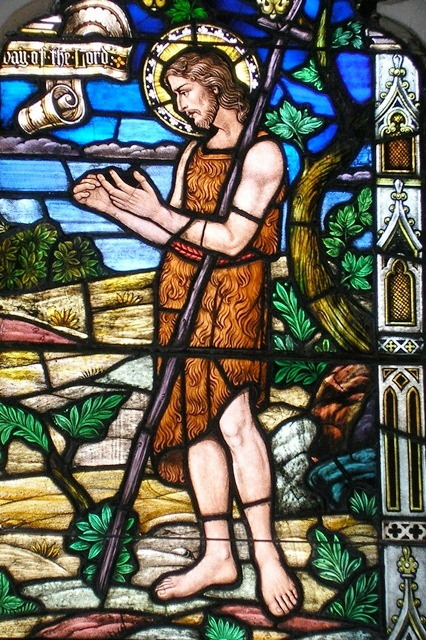
But Mark makes no apologies. He doesn’t care to tell us where Jesus was born, or what his family thought of his birth, or who even bothered to notice that he was born. John comes from the wilderness, with all the markings of most ferocious and uncompromising of Hebrew prophets. John is an outsider to the power elite, and those elites have not yet seemed to notice how many people are attracted to John’s message: repent, and your sins will be forgiven. Repent, turn around, get back on that path where God led you from the wilderness to the Promised Land, where God led you when you were distracted and unhappy, and brought you into a promise of right living and abundance and a zone of connection with God. John is not preaching anything new, but it is gold to those people from Judea, fed up, perhaps, with the demands of the elite, bored, perhaps, with the superficiality of a religious culture that bends to the demands of a foreign occupying army, worried, perhaps, that that army will someday turn on them no matter how much they bend and accommodate. Using these old words of repentance, these familiar cadences of the prophets, John is giving the people something real and authentic, from the earth on his sandals to the water dripping off his hands. The elites back in Jerusalem are concerned with their politics and manners and positions and power; the people are flocking to the edge of Galilee because John is offering them the chance at something real.

In these few words, these scant verses, Mark makes it clear where Jesus stands: with John. Jesus joins John not only in his critique of the powerful – the ones who need to repent but do not know it – but Jesus also joins John in his solidarity with the ordinary people who are longing for a better way of life, and who hear hopeful words that it could happen from this strange and unsettling outsider. Jesus did not pull John aside and say, hey, let’s go and do this in downtown Jerusalem where some really important people will see us and we’ll make a big splash. Jesus, from an ordinary town in a not-so-important place, comes with ordinary people to find the waters of life at this place on the edge of the wilderness.

Reading the story of Jesus from the Gospel of Mark is very appealing, because I think we, too, live our lives in this sacred geography between the Jerusalem of the powerful elite and the Galilee of the struggling ordinary. It’s not so long ago and far away; there are many places in North American, even in Onondaga County, that can be described that way.

That’s where we are, we 21st century Christians, caught in this sacred geography, knowing that the Good News comes from the margins, and that the water of life flows in the wilderness, yet living lives that are perhaps a little too distracted, a little too comfortable, a little too worried, to venture over there. Yet to that un-comfort zone is exactly where we are called, by John, who leads the way, by Jesus, who plunges in, and by God, who assures us that when we follow on that path, we, too, will be God’s beloved, with whom he will be infinitely well pleased.

Wednesday, January 4, 2012

... but does a human form display


Christmas I     January 1, 2012
Isaiah 61:10-62:3; Ps. 147
Galatians 3:23-25,4:4-7; John 1:1-18

Bethlehem has come to us. God in his Son is born into our lives. John's prologue to his Gospel is true: the light shines in the darkness, and though the world cannot understand it, neither can the world put it out. Poet William Blake put it succinctly:

God appears and God is light
To those poor souls who dwell in Night;
But does a Human Form display
To those who dwell in realms of Day.

All of us come to Christmas with the same hopes and fears: we share with the prophet Isaiah the hope for the restoration of the righteousness of the Lord and the vindication of God's justice. We share with St. Paul the hope that now that Christ has come we might be freed from slavery to the law and live in freedom as the children and heirs of God. Our Christmas liturgies focus on God's entrance into history as one of us: the infant Jesus is the new Adam, and Bethlehem the site of the new creation story. Christmas, the story of Jesus' birth, is a story about us and how we come to know God.

The great secret and glory of God is the redeeming power of love given to us in the life of this person whose birth we celebrate. Jesus, son of Mary, who never traveled more than 50 miles from his birthplace, who never wrote a book, who never left any permanent memorial of his life, who was executed by civil authorities for reasons which have embarrassed humanity ever since, who was rejected by his own people: this is the babe in the manger. Following the death of this man, many strange things happened, the most familiar being that after his public execution he rose from the dead and was seen and continued to teach and be with his friends.

If this were all there was to the Christ story, we could easily drop it there, but equally mysterious was the eventual appearance of a growing number of people who called themselves followers of this man, Jesus.
Tales of strange events taking place began to travel on the grapevine: tales of robbers becoming law-abiding citizens, dishonest merchants become concerned for the welfare of others; tales of masters treating their slaves as brothers and sisters; of fanatics and bigots like Saul of Tarsus who changed their lives and began to preach an unheard-of message of love not law as the standard of conduct. The Good News spread across the Mediterranean. It filtered into the ranks of Caesar's subjects and into his own household. Wherever it went a new kind of person appeared, one who completely confused the pagans. These were people who spread joy, for whom life was exciting, who faced the future with anticipation and hope, who took care of each other and the poor and lonely around them.

When Christ enters a life, that life is changed. A new person is born. That is the Good News, and that is what we celebrate right now: not just the birth of a baby, but the Advent of Christ into the world, into the lives of men and women, boys and girls.

God comes in a form we understand. If we live in gloom or trouble, God first appears to us as light. But if we already have had a glimpse of that light, God comes to us as one of us, embodying our hopes for righteousness and justice, love and freedom, giving us something tangible to hold on to and model our lives upon until the day of the Lord comes.

Wednesday, December 28, 2011

God pitches God's tent

Christmas Eve 2011
Isaiah 9:2-7; Psalm 96
Titus 2:11-14; Luke 2:1-20

“Occupy” seems to be the word of the year. Starting with the uprisings of the “Arab spring,” protests seemed to bubble up the world over – protests against dictators, against income inequality, against debt, against corporate greed and against leaders who seemed to do nothing about those things. It is hard to know what will come of this movement, or even it if is a movement. It is hard even to know what all these occupiers had in common – other than a determined and at times joyful hope that the world, as bad as it is, could be a better place.

Hannukah and Christmas have nothing to do with each other, in terms of the origins of each festival in our respective religions traditions. It’s not like Easter and Passover – Jesus was in Jerusalem to celebrate the Passover when he went to face his death. Christmas, or the observance of Jesus’ birth, was not celebrated on any fixed day until the church came to inhabit the boundaries of the old Roman Empire. There was always some confusion between the return of the sun, the rise of the sun – “SUN” – god and the birth of the son – SON” – of God, and the church just kind of went with that confusion. As Christianity spread north it made sense to use the existing festivities around the solstice and the return of the sun, a powerful sign of hope in the dark and cold and want of winter. Christmas became a sign of resistance to an oppressive darkness in hopes of a brighter spring.
That is where we begin to see the theological connection between Hannukah and Christmas. Hannukah is a festival of resistance and of light. When Jewish militants finally overthrew the Hellenized occupiers of the Temple – who had defiled it with altars to pagan gods -- they cleansed the Temple and found enough oil to burn the candles for one day. God blessed the miracle of this new occupation, and these righteous Jewish occupiers, by giving them enough oil to burn the lights for eight days. As Judaism spread north throughout Europe, this Hannukah celebration of the triumph God’s righteous ones over their political and religious oppressors also became a sign of hope in a dark and cold world.

Enveloped as Christmas is by thousands of years of traditions, it is easy to forget its simple, yet revolutionary origins. God in all of God’s divine majesty chose to come to earth, to occupy, as it were, the body of one poor peasant woman long enough for her to give birth to a child. This little boy, this Jesus, is Emmanuel, God with us. God dwelling with us. God pitching God’s tent, as it were, in the Zuchotti Park of a barn in the back of an inn in Bethlehem. We forget that the reason that Mary and Joseph had to make this difficult journey in the first place was because of the political and military occupation of Palestine by the Roman Empire, and its arbitrary rules that all should be enrolled, so that all could be taxed.

Think about it: God could have chosen to be born in a much nicer place, where more people could have heard about him and taken care of him. But no: God chose to be born in a rough and vulnerable place, among people who were outsiders and rabble-rousers. Call to mind the words his young mother said, when she learned that she would bear this child: he will bring down the mighty from their thrones and exalt the humble and meek. He will fill the hungry with good things, and send the rich empty away.

God chose to be born not among those who would politely wait their turn for the privileges they knew were theirs. God chose to be born among those who were hungry, and impatient, among people who took risks because they had nothing to lose and everything to gain. God chose to be born in a makeshift tent in an occupied zone, and his birth made those people wild with hope and joy -- hope that God is moving once again with a mighty hand, and joy that the revolution has begun.

This occupy movement began small 2000 years ago – began among the poor and the humble, and among people who knew God intended better things for them and for the world. The 1% of those days cared not a fig for them. Depending on how you divide up today’s world, all of us here could be considered among the 1%. But we are here tonight because we have heard the angels sing. “Good news,” they say. “Good news for all.” We are here tonight because in our hearts we are among the 99%, hopeful indeed that the world can be the bright and shining place God created it to be. 

Wednesday, December 21, 2011

Hold on. Things are beginning to turn around.


Advent 3-B -- December 11, 2011
Isaiah 65: 17-25; Psalm 126
1 Thess. 5: 12-28; John 1: 6-8, 19-28

Apparently, the Syracuse Stage production of The Lion, the Witch and the Wardrobe tries to downplay the fact that the author, C.S. Lewis, wrote these rollicking good children’s books – The Chronicles of Narnia -- as both adventure stories AND as Christian allegories.

If you haven’t seen the play or any number of film versions, or read the books, I don’t think I’ll be spoiling the story to say that Aslan, the lion who is a figure, or representation, of Christ, is willing to die at the hand of the White Witch so that the life of one of the other characters is spared. This is to fulfill what the White Witch and Aslan call “the deep magic,” a spell, or incantation, or promise, written in to the essence of Narnia at its beginning. But Aslan, killed on a great stone table, comes back to life. It turns out that the Witch does not know of a deeper magic still, an older magic, that turns everything around:
Her knowledge goes back only to the dawn of time. But if she could have looked a little further back, into the stillness and the darkness before Time dawned, she would have read there a different incantation.
The death of Aslan, the innocent, causes the table to crack, and “death itself starts working backward.”
The promise of new life comes from the depths of that Deep Magic, comes from the stillness and darkness before the dawn of time.

Lewis got that idea of the Deep Magic from the Gospel of John, from the verses which come before the passage we read today. The words are familiar, and we’ll read them again during the Christmas season: 

In the beginning was the Word, and the Word was with God and the Word was God. He was in the beginning with God. All things came into being through him, and without him not one thing came into being. What has come into being in him was life, and the life was the light of all people. The light shines in the darkness, and the darkness did not overcome it.

There was a man sent from God whose name was John …

In the words of Aslan, John the Baptist comes from that time of the Deeper Magic, from the time before the creation of the world, from the beginning of the Word itself.

One way to think of Advent is as the time we remember that we still have time. It’s the time we remember the way the world was created to be. Things may have gone awry since that first creation, but God is promising to renew it all: God will create a new heavens and a new earth. The ancient city of Jerusalem will be a joy, and its people a delight.

This passage from Isaiah was written after the people of Israel had returned to Jerusalem. For generations, they had been punished by God and exiled to Babylon. They were punished for not following God’s commandments to live righteously, to care for the poor and stranger, to worship God alone. Then God forgave them, gave them another chance, let them go back to Jerusalem. But here was the challenge: were they going back to “the good old days,” with the kind of life choices that took them down the path to the way of living God did NOT like? Or this time, living in this new Jerusalem, did they realize that to live the good life God wanted them to live meant doing things a different way?

The prophet Isaiah came to people like us. Listen, he said to the people of Jerusalem who still remembered the hard times in Babylon, but were hoping things could get back to the way they used to be. Listen, he said. Two things: it is only God who creates, and in God’s own time. And, you, people of God, have to hold up your half of the bargain. Remember the commandments: love God, and love your neighbor as yourself.

The prophet John the Baptist came to people like us. Listen, he said to the people of Jerusalem who were living under the hard times and oppression of the Roman Empire, an economic, political and social system where the decisions made in faraway places wreaked havoc in their daily lives. People who needed hope. People who had forgotten some of those essential commandments, to love God and to love neighbor as oneself. People living in darkness, tripping down crooked paths. Repent. Turn from those ways, for the kingdom of heaven is about to get here. You know what God wants you to do. You know how God wants you to live. Do it. Now is the time.

Advent is for two kinds of people. It’s for people who need to realize that God’s commandments include social justice – who haven’t quite worked out that loving God and loving neighbor are inseparable. Advent reminds those people that it’s time to get going in the good works department.
And Advent is for people who care deeply about justice – who know the world can and should be a better place – who devote their time and resources to doing good works – who hear these promises for a new heaven and a new earth and then wake up day after day in the same spot. Advent reminds those people that God alone creates, and that the new heavens and the new earth are on their way.

It’s the message from the Deep Magic from before the beginning of time. Repent, and get ready. Hold on, and hope. Things are about to turn around.

Tuesday, December 6, 2011

A new heavens and a new earth

Today is December 6, the Feast of St. Nicholas, patron saint of, among many good causes, children. The Advent calendar many of us have urges us today to think, pray and care for children -- to do something to improve their welfare.

St. Nicholas performed many wondrous deeds, including the one illustrated at the right. He heard of a poor family, who would soon be forced to sell their daughters into slavery, and he would come by at night and throw sacks of gold coins into the house, enough so that the family debts were paid and the girls were free.

This story must raise alarms for all children, the fear of being sent into forced separation from one's family. We who are adults hear another horrifying dimension to this alarm. Would these girls be sent not only into servitude, but into sexual slavery? The steady drumbeat of reports of world-wide human trafficking -- a polite way to say that women and children are sold into sexual slavery -- makes us long for more brave Nicholases to intervene and prevent these daily horrors.

We in Syracuse read in today's newspaper that a local center that works with abused children noted that among the people they served last year, 143 were under age 6. A local basketball coach, a friend to many in the community, is accused of hurting boys. Head coach Jim Boeheim, after an initial, and understandable, response in defense of his friend, learned, painfully, that such abuse is all too common. Boeheim's candor in revealing not only his remorse, but a change in heart, is commendable.

As public opinion rushes to the side of the victims -- and it is a long overdue and frequently too late "rush" -- I remember that many of the perpetrators were themselves abused as children.

St. Nicholas, who rushed to the rescue of those girls who were to be sold into sexual slavery, pray for those to whom no one rushed, no one saved, no one heard. Pray for those who grew up to hurt and damage others, as they themselves were hurt. Help us, we pray, to hear their cries of anger and pain before they hurt others; and help us, we pray, to repent and ask God's forgiveness when we have not intervened but only salve the wounds of those who cry now. 

Advent 2-B; December 4, 2011
Isaiah 40:1-11; Psalm 85
2 Peter 3: 8-15a,18; Mark 1:1-8

We wait for a new heavens and a new earth, where righteousness is at home.

I’m going to take a risk here, to talk about something we all may not share: parenthood. I’m hoping, though, that even if you are not a mother or a father, that you can resonate with the hopes I had – that I think many parents have – at the birth of their children.

The hopes I had were hopes that the world my child would grow up in would be a wonderful place. I hoped my child would not be terrified by war, famine or disaster. I hoped my child could run and play in green fields and breathe clean air. I hoped for a world where there was enough of everything to go around. On a more mundane level, I hoped for a world free from junk food and commercial television. Whatever I hoped for – and I imagine you have a list of your own hopes, as well – it was a version of the new heavens and the new earth. And in a way, the experience of life now, in the world as it is, is the experience of the exile. With my hopes for that new heavens and that new earth, living in this earth seems kind of like a displacement. There is a loss, when life does not turn out the way I thought it would.

The prophet Isaiah was speaking to people in exile – the people of Israel living in captivity in Babylon. How could they worship God in that foreign land? How could they know who they were as God’s people when the Babylonian powers defined them as slaves, as captives, as homeless, as poor, as non-citizens, as “less than”? So look at what the prophet Isaiah says to these displaced, grieving persons. The prophet Isaiah speaks God’s words of comfort to them in the middle of their deep dis-comfort. In their current experience of wilderness, God reminds them of their first highway in the wilderness, when God led them out of Egypt into the Promised Land, the journey of God’s chosen people. God agrees with them that the reality of life may not change – “the people are grass, the grass withers, the flower fades” – but God brings something more: a herald of hope. The exiles are defined not by the Babylonians who bad-mouth them, but by God who stands up for them, God who rules with a mighty arm – but who then embraces them like a tender shepherd.

What can we learn from these people in their long-ago exile? We who may feel a little displaced and out of step in the world we live in?

We can know that this ragged space of our lives is where God meets us. Here. Now. The world may not make sense at times, but that craziness does not define us; God does.

Because we know we are God’s, we can resist the things that make us mad, things that we know are out of whack, things that are unjust and cruel and crazy.

Because we know we are God’s and we know that God meets us here, in this place, we know that whatever we do to make this world a better place, the place we know God would want it to be, will not be in vain. Jeremiah, the other prophet of Israel’s exile, put it this way: “Seek the welfare of the city where I have sent you into exile … for in its welfare you will find your welfare.” Here. Now. In this world that does not live up to our expectations. In this place where we feel out of place. This is where God speaks to us, and this is where God expects us to flourish.

When Mark the gospeller told this story of John the Baptist, he knew these themes would resonate with his audience. He knew that they would understand what it meant to be called by God out of the wilderness. He knew they would be familiar with the strange messages prophets would bring. He knew they were people who felt out of place in their own world, people who knew the world was out of whack and unjust, people longing for a new heavens and a new earth. John the Baptist came out of the wilderness to people who felt exiled in their own countryside and said, like Isaiah, Here is your God!

What do we make of John the Baptist? Does that wilderness from which he hails make any sense to us today? I think John’s message, which is unsettling and disconcerting, may not make sense to people who are satisfied with the status quo of this world. It may not be a message of hope to people who like the world the way it is. But to those of us who have higher hopes, who seek a new heavens and a new earth, this stranger with his rough clothes and his peculiar diet, brings very good news indeed.

Saturday, December 3, 2011

You are not lacking in anything


Advent 1 B November 27, 2011 Isaiah 64:1-9; Ps. 80
1 Cor 1:3-9; Mark 1.3:24-37
There were people who had a wonderful time this Thanksgiving weekend. People who connected with loving family and friends, people who heard wonderful stories, people who greeted long-lost friends. There were people who heard difficult news this Thanksgiving weekend, heart-breaking news, earth-shaking news, people for whom family and friends were more important than ever. There were people who were lonely, people who were over-worked, people who did not have enough to eat. There were people who started arguments at the dinner table, and people who worked their best to prevent any discord. It was a Thanksgiving weekend of extraordinary weather, and ordinary grace.

There is a disconnect, isn’t there, between all that goes on over Thanksgiving weekend, and what scripture we read, and hymns we sing, on this first Sunday of Advent. We read lessons about the end of time, of God’s anger and human failing, of a darkened heaven and falling stars, and urgent messages to keep alert.

Amid all the extraordinary moments, and ordinary grace, the family tensions and the not-quite-fulfilled expectations, we get this message that puts us a bit on edge: keep alert. You do not know when the time will come. It is like a man going on a journey …

We are embarking on a year of reading how the Gospel of Mark interprets the life and ministry of Jesus. Mark is often described as a stark gospel – it is certainly the shortest one. Mark is not interested in how Jesus was born – no stories of angels or shepherds, no miraculous birth, no wise men from the east. Like today’s reading, there is a sense of urgency to all of Mark’s gospel. Mark urges all of us to take this journey, to keep awake and alert to what may be ahead.

Mark’s urgent concern for us has to do with following Jesus. We who follow Jesus are “on the way.” Today we are embarking on this journey, on the way, following Jesus, travelling through a sacred landscape where we will encounter signs and wonders, where we will run up against opposition and obstacles.

The advantage of a four-day holiday weekend is that it takes us out of our normal routine enough to have a minute, at least, to reflect. To stop and think. To give thanks for our lives when they are going well, for our blessings, for those who love us, and who let us love them. Are we “on the way,” however we have been able to understand the pull that Jesus exerts on our lives? Or are we off the path, distracted by things that are not important? Are we alert, or have we fallen asleep?

The master in today’s story, like the King in last week’s, would not be interested in the frenzy of shopping on “Black Friday,” but he would likely be interested the fear and tension that drives people to “shop ‘til they drop,” to open their stores at all hours of the day and night, to pronounce breathless reports on consumer spending like all of our lives depended on what happened this weekend at Toys’R’Us or Wal-Mart or Neiman-Marcus. The master in today’s story, like the King in last week’s, would be grateful for all the turkeys delivered to needy people this week, but wonder what we were doing with our money during those other 51 weeks, and why we put up with a society that distributes its resources in such a lop-sided fashion. Be awake, the master says. Keep alert. What is going on here? What are the signs of our times, that we can interpret as well as gardeners can interpret the coming spring from the shoots of the fig leaves? What do we see around us, that God wants us to pay attention to?

We are about to rush into the work-week, I know, as well as into the frenzy of our holiday season. But today, this afternoon, this evening, take stock, one more time. What has God called you to pay attention to during this weekend’s respite from everyday life? What moments of ordinary grace, or extraordinary clarity, lead you to know what it means to follow Jesus “on the way?” How can you keep alert to those signs, during these days ahead, to know what is distracting you, pulling you off from the path, away from the journey?

The season of Advent is the church’s ancient custom to remind us that all around us are the signs of God’s goodness, God’s reign, God’s intention for how we live our lives as individuals and as a whole society. The signs may be as small as the shoots of tiny leaves, or as large as a billboard along the highway. Those signs are in the blessings of our lives, as well as in the heartbreaks. Advent reminds us: you are not lacking in any spiritual gift as you await the revealing of our Lord Jesus Christ.

You are not lacking in anything. The signs are all around us. Keep awake.

Saturday, November 26, 2011

The King comes down off the throne


Proper 29 A; November 20, 2011
Ezekiel 34:11-17; Ps. 100 
Ephesians 1:15-23; Matthew 25:31-46

Spoiler alert: close your ears if you have NOT read The Lion, the Witch and the Wardrobe, because I’m going to tell you the ending. The king returns. The righteous ruler is placed up on the throne. Justice is restored. Power joins with mercy. The meek – or at least the beavers, nymphs, satyrs and other creatures, led by four sturdy, British children – inherit Narnia, the kingdom prepared for them by Aslan.

Spoiler alert again. C. S. Lewis’ friend, J.R.R. Tolkien, also writing in the terrible, war-torn years of the 20th century, ends The Lord of the Rings in the same way. The king returns. The righteous ruler is placed upon the throne. Justice is restored. Power joins with mercy. The meek – this time a Rainbow coalition of elves, dwarfs and swarthy men led by four sturdy, British hobbits – inherit Middle Earth, the kingdom prepared for them by Gandalf.

The British have built this longing for the return of the righteous king into their civic life. When the Tudors came to the throne in the late middle ages, they created a back story to give their ascent to the throne some legitimacy. The Tudors recreated the legend of Arthur, the true king of all the Britons, whose Round Table of equality and chivalry brought order to violent warlords. Even to this day the British monarchs vow to step aside if Arthur awakens from his slumber in Avalon and returns to rule England’s green and pleasant land.

We can chuckle at the quaint notion of “the return of the king.” After all, we Americans overthrew the king in 1776, dethroned in place of democracy. And yes, of course, Britain is a democracy, too – and in fact, democracies do a much better job than monarchies at maintaining order and distributing justice.

But when times are bad, social conditions unsettled and the way to a prosperous future unclear, do not these stories of a righteous king coming to settle account appeal to our deep longings? Maybe we can learn something from them, not to recreate a past that perhaps was not ideal, but how we can look to the future – how we can use our lessons from scripture – of Ezekiel’s description of the Good Shepherd-the Good Ruler, and of Matthew’s description of judgment day as righteous king coming to settle accounts.

How about another story? Ireland, at the turn of the 5th century, was a flourishing pagan culture. Patrick, who had lived there for some time as a slave, heard a call from God to evangelize the Irish. It was a culture governed by kings who were the representatives of the gods, who had to be appeased through blood sacrifice to bring about fertility and prosperity. Patrick did many things in his mission to the Irish, but this one point has relevance here: he replaced their warrior kings with “the high king of heaven,” their angry and fickle gods with a “God they could depend on.” Patrick used the image of the king bringing order to society not in a backward-looking, nostalgic way, but with a bright vision of a new society: a society of peacefulness, of new relationships, of a God who brought life from death.

Move ahead to the end of the 19th century, to Episcopal churches in cities like Chicago, New York, Boston, Philadelphia. It is the height of the industrial revolution, and suffering among the working classes is widespread, without any of the safeguards such as child labor laws, a 40-hour-work-week, health and safety standards. Many Christians are moved to alleviate this suffering, inspired by the reading of passages like today’s Gospel. Among the boldest leaders in this “social gospel” movement are Episcopal clergy and parishes. People at the time noted the paradox of the elite, aristocratic Episcopal Church at the forefront of movement of solidarity with the poor. Oddly enough, it is Episcopalians’ understanding of “kingship,” of a society guided and led by the church, that inspired their activism. The social gospel took what the righteous king would do and democratized it, advocated the spreading-out of power and privilege across society. They took this powerful image from the past – a righteous king restoring order during a time of social upheaval -- and adapted it for movement into the future.

Both lessons from Ezekiel and Matthew overthrow our traditional understanding of the regal monarch, the warrior, “the king.” Kings were to be the shepherds of Israel, feeding the hungry, binding the broken, gathering the lost. Ezekiel denounces those made themselves fat at the expense of the people they were there to serve. The king in Matthew comes down entirely from his throne, not just to help but to identify completely with the poorest and most desperate of society. By loving the stranger and the outcast, we indeed love the king; we love God.

The way these lessons take old images and turn them around for new, challenging times can be helpful to us Christians in this time of social dislocation. We may have to describe Christ the King in words from the past, using the old monarchical words and images that really don’t work anymore. But the reality they point us to is one very different indeed: it is the reality of God’s justice, where all the poor and neglected are welcomed, where their suffering is even part of God’s own self. This high king of heaven is indeed a God we can depend on -- not a benevolent despot who “knows what is good for us;” but a God who became one of us, and who took all of human nature into the divine.

We enter Advent next week with these “marching orders” of engagement, sacrificial giving, solidarity and hope. “The king shall come when morning dawns, and light triumphant breaks,” we will sing in the hymn at the end of the service. “and let the endless bliss begin, by weary saints foretold, when right shall triumph over wrong, and truth shall be extolled.”

How wonderful it is, even in these darks days, with no human king on the horizon, no Aslan getting ready to roar, no Gandalf on the ridge with armies of thousands behind him to slay the wicked orcs, no Arthur coming back from Avalon – how wonderful it is that we have been given the words to hope for something real.